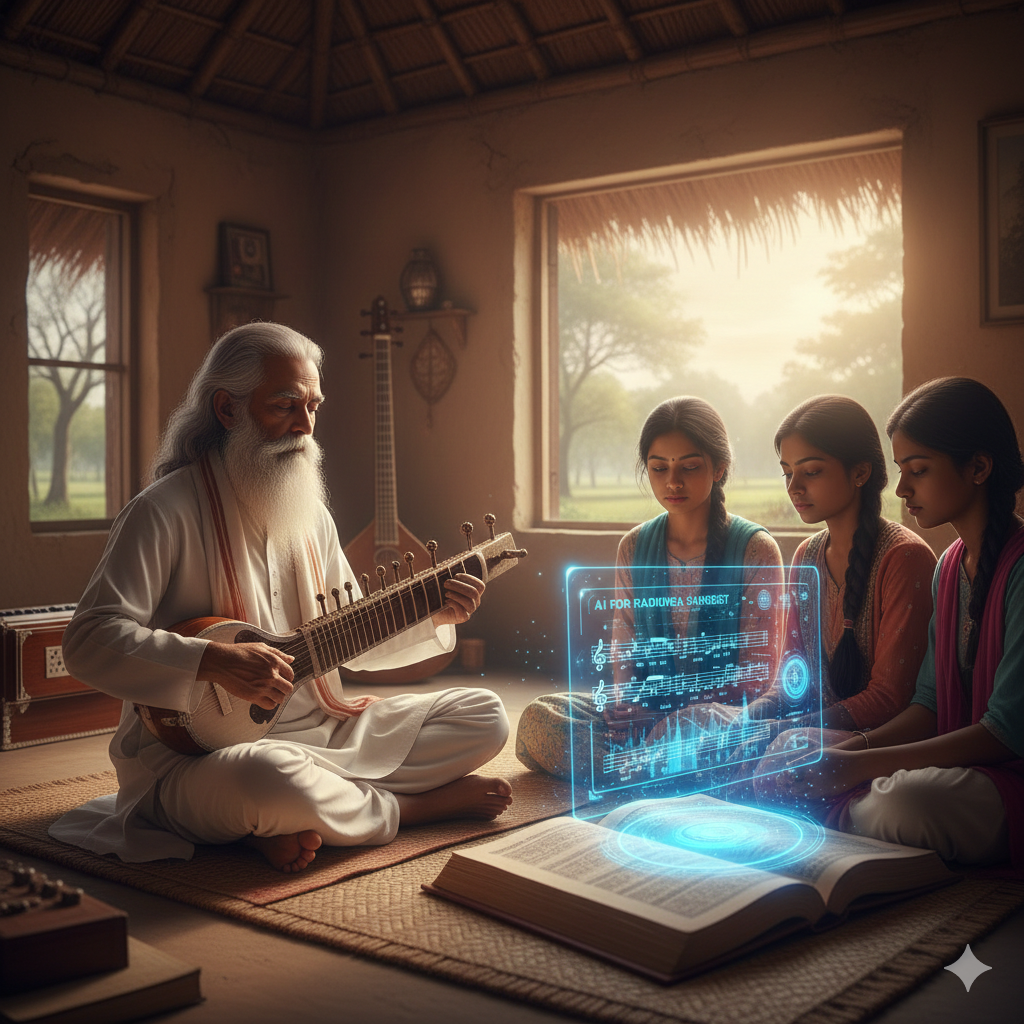
Imagine a quiet lane near Rabindra Sadan, the heart of Kolkata’s cultural life. Inside a traditional music school, the melodious strains of “Jodi Tor Dak Shune Keu Na Ase” fill the air. For generations, this is how Rabindra Sangeet has been taught—through the sacred guru-shishya parampara, where knowledge is passed down directly from teacher to student. This tradition is the soul of our shonshkriti (culture). But in a world that is changing faster than a Gariahat tram during office hours, even our most cherished institutions must think about the future. What if we could blend the sanctity of the gurukul with the power of modern technology, not to replace our traditions, but to strengthen them for the next generation?
Honoring Tagore’s Legacy in the Digital Age
The very idea of using Artificial Intelligence in the same breath as Rabindra Sangeet might seem strange to many. The fear is that technology will dilute the bhaav (emotion) and human touch that is central to Tagore’s music. However, this is a misunderstanding of what modern tools can do. Think of a master karigor in a Burrabazar workshop; a new, advanced tool doesn’t replace his skill—it simply helps him execute his vision with greater precision and speed. AI, in this context, is not meant to be the guru. It is a tireless, incredibly accurate assistant that can handle the technical groundwork, freeing up our respected teachers to focus on what truly matters: teaching the soul of the song.
Preserving our musical heritage is a monumental task. Over the decades, countless renditions of Tagore’s songs have been recorded, each with its unique nuances. Manually transcribing the swaralipi (musical notation) from these recordings is a slow, painstaking process. An AI tool can listen to these classic recordings and generate accurate notations in a fraction of the time. This would create a vast, searchable digital archive, ensuring that rare or complex versions of songs are not lost to time. A student in Salt Lake could instantly access the precise notation from a recording by a legendary artist, something that was previously impossible without direct access to a master archivist.
Most importantly, this approach makes Rabindra Sangeet more accessible and engaging for today’s youth. The new generation is digitally native; they learn, communicate, and create using technology. By introducing an AI-powered tool for learning notes, a music school can connect with them on their terms. This isn’t about dumbing down the art form; it’s about providing a modern pathway to a timeless tradition. Attracting more young grahak (customers, or in this case, students) is essential for ensuring that Tagore’s music continues to thrive, not just survive, in the 21st century.
- Key Benefits of Modernization:
- Preservation: Digitizing and archiving rare musical renditions.
- Accessibility: Making accurate notes available to students anywhere.
- Engagement: Attracting younger learners with modern, interactive tools.
AI for Flawless Rabindra Sangeet Transcription
So, how does this actually work? An AI transcription model for music is trained on thousands of hours of Rabindra Sangeet. It learns to identify the specific notes, rhythms, and melodic patterns that are unique to Tagore’s compositions. When you feed it a new audio file—be it a classic recording or a teacher’s live demonstration—the AI “listens” and translates the sound into a formal swaralipi. This process, which could take a human expert hours or even days, can be completed in minutes. Imagine the time saved, especially during the pre-Pujo rush when schools are preparing for cultural programs and need materials for dozens of students.
For the music school as a business, this is a game-changer. It elevates the institution from just another music dokan to a center of excellence and innovation. Teachers, who are the most valuable asset, can now dedicate their class time to refining a student’s vocal expression, pronunciation, and emotional delivery, instead of spending half the class writing notes on a board. The school can develop its own standardized, high-quality digital study materials, which can be offered as part of a premium curriculum. This builds a strong brand reputation and positions the school as a leader that respects tradition while embracing the future.
Furthermore, AI brings a level of consistency and accuracy that is difficult to achieve manually. Rabindra Sangeet notations are guided by the authoritative Swarabitan, but different teachers might have slight variations in their personal transcriptions. An AI, trained on the official sources, can produce a perfectly standardized notation every single time. This eliminates confusion for students and ensures that they are learning the composition exactly as it was intended. This precision is not about removing artistic freedom; it’s about building on a flawless foundation.
- Practical Advantages of AI Transcription:
- Speed: Drastically reduces the time needed to create musical notations.
- Efficiency: Allows teachers to focus on performance and artistry.
- Accuracy: Provides standardized, error-free swaralipi based on authoritative sources.
Pro Tip
Start small with a pilot project. You don’t need to build a massive system overnight. Collaborate with a local tech startup in Kolkata to develop a proof-of-concept. Begin by using AI to transcribe ten of the most popular and frequently taught Rabindra Sangeet songs. Use these digital notes in a single class and gather feedback from both the teacher and the students. This low-risk approach will help you understand the real-world benefits and challenges before making a larger investment.
In the end, the goal is simple: to ensure that the light of Rabindranath Tagore’s music shines brighter than ever. By thoughtfully integrating AI into our traditional gurukuls, we are not abandoning our roots. Instead, we are building a bridge between the past and the future. A music school near Rabindra Sadan, using AI to perfect its teaching materials, can become a beacon for others, showing that tradition and technology can create a beautiful symphony together. From the students practicing in Gariahat to the global diaspora hungry for a connection to their culture, this new-age gurukul can keep Tagore’s legacy vibrant, accessible, and perfectly in tune for generations to come.
Leave a Reply